Unknown's avatar

About Dally Messenger

Principal of the International College of Celebrancy

The Power of an Authentic Marriage Ceremony

by Dally Messenger |||
(Principal of the International College of Celebrancy)

The COVID-19 pandemic was a global disruptor, shaking the very foundations of how we live and connect. In many parts of the Western world, gatherings were abruptly outlawed. Here in Australia, for example, only five people—the bride, groom, and two witnesses—were allowed at weddings. Funerals were reduced to just ten attendees, all masked and distant, stripping these milestones of their usual intimacy.

In the wake of such unprecedented restrictions, many celebrants have grown used to conducting shorter, bare-bones ceremonies. And yet, this trend poses a deeper question:

Why bother with a full ceremony when a minimalist version will do? Does it really make a difference? Once you’re married, aren’t you simply married? After all, how can you be more married than that?

The value of a marriage ceremony is not in its legal formality but in its symbolic and emotional power. Marriage as an institution has thrived for millennia. Only recently has the law stepped in to record unions, merely for societal management—custody disputes, property rights, that sort of thing. But to reduce marriage to a cold legal contract misses the point entirely. The phrase “legal marriage” diminishes the depth of the commitment. In truth, these quick and superficial ceremonies are little more than paperwork formalities.

When Lionel Murphy crafted Australia’s civil marriage program, he envisioned something far greater. He believed that civil marriages could be the most profound and meaningful in the world. With the guidance of a skilled celebrant, couples could create a ceremony that reflects their deepest values and beliefs—a ceremony that feels real in every sense. Every detail can be personally tailored: the vows, the location, the tone, the mood. Authenticity at its peak. And in that moment, a couple becomes more than just married—they become united on a psychological and emotional level that transcends mere legal documentation.

You can absolutely be more married than just “married.” The act of co-creating a heartfelt ceremony with a thoughtful celebrant reshapes how couples see themselves. Something shifts within them. In preparing the vows, choosing the music, reflecting on their love through stories and poetry, couples gain an entirely new understanding of what it means to commit to one another. A true wedding ceremony isn’t just an event; it’s a rite of passage, an inner transformation that engraves the meaning of marriage onto the hearts of those involved.

This profound shift is what inspires dedicated celebrants to craft the best possible ceremonies for each couple. The ceremony becomes an anchor, a memory so rich that it serves as a psychological wellspring, something couples can draw upon during tough times. As Dr. John Gottman, a leading expert on relationships, explains: the memory of a powerful ceremony strengthens marriages long after the vows have been said.

You can also be more married socially. A well-thought-out wedding ceremony doesn’t just unite the couple—it transforms how others see them. Family and friends gather not simply to celebrate but to witness the couple’s commitment. By organising their wedding and inviting loved ones, couples are, consciously or not, seeking recognition and support from their community. Once the vows are exchanged, something changes. The couple is no longer seen as two individuals—they are recognised as a unit, and everyone around them treats them accordingly.

Social perception matters. We are deeply influenced by how others see us. Couples want their peers to view them as people of integrity, who are deeply invested in making their marriage work. They want the world to know that they are serious about their vows, that they aspire to build a lasting and happy family. And the ceremony, with all its symbolism and tradition, broadcasts that message to everyone present.

Think about it. If you’re getting married and inviting close friends and family to the ceremony, that invitation strengthens your relationship with them. Including someone in your wedding party shows them they hold a special place in your life. It’s an unspoken message: “You are part of our journey. You matter.” Strengthening bonds is not just a metaphor; it’s a reality you can craft.

You can also be more married culturally. A wedding is the ultimate expression of a culture’s values and creativity. It draws upon the best of the visual and performing arts, from the breathtaking venue to the heartfelt music, the moving poetry, and the timeless stories. The wedding ceremony is the pinnacle celebration in every culture across the globe. Through it, couples and communities alike absorb the beauty of language, art, and tradition. And it is through marriage that families, the very foundation of culture, are created.

This is precisely why Lionel Murphy, the visionary behind Australia’s civil celebrant movement, insisted on crafting ceremonies that were not only legally binding but emotionally and culturally transformative. By doing so, we don’t just strengthen individual relationships; we elevate the collective happiness and resilience of society itself.

The History, Nature, and Development of Ceremony

See Module 1,

The History, Nature, and Development of Ceremony is a step on the journey towards becoming a professional celebrant, a person steeped in the understanding of ceremony. Understanding inspires and motivates.This course enables you to transcend the mere “doing” of a ceremony and embrace its transformative power. It is a course of study, including practical field work, designed to shed light on the path to in-depth best practice. Each participant in the course is assigned their own individual guide. We have chosen experienced celebrants of excellent reputation to be our tutors and examiners to assist you, the student, to begin your study, to keep at it, to enjoy it and to complete it.

Ceremony, in all its aspects, is a significant element in the range of human experience. As a genuine celebrant, it is important for you to not only understand but to deeply believe in the profound impact ceremonies have on people and society. Whether it is marking life’s milestones, honouring noble achievements, or any other purpose, a genuine celebrant recognises that their calling lies in crafting meaningful and authentic rituals, that resonate with individuals and communities. Such transcend the ordinary and leave an indelible mark on hearts and minds.

One of our tutor-examiners,
Genevieve Messenger.
genevieve.messenger@gmail.com
For others, see below

Join us at the International College of Celebrancy, where our course is not just a curriculum, but a gateway to deeper understanding. Absorb the wisdom of scholars and social visionaries such as Arnold van Gennep, Joseph Campbell, Michael Mead, Mircea Eliade, David Oldfield (of the USA), Lucia Blums, Mary Hancock, Louise Mahdi, Anne Witherford, Juliet Batten, Robert Fulford, and Dally Messenger III. Our program transcends the ordinary, fostering in-depth competence, creativity, and humility essential for a celebrant’s journey. With practical skills honed to perfection and a profound sense of professionalism instilled, graduates emerge as beacons of authenticity and grace in the realm of celebration.This is also a course of personal enrichment, an experience that extends beyond celebrant boundaries.
More about how the course operates
Talk to one of our tutors listed below
Enrol now.

Celebrants: a destructive excessive number

Saturday, 12 October 2019

Memo: To Public Servants and Associations

Meeting on October 28th, 2019. 

Re the Number of Celebrants and
the sustained deluging of the market.

Dear Public Servants and Associations,

I am still alarmed that no discussion seems to be allowed on the one and the most important problem which is so destructive of the celebrant program – that of excessive numbers.

I keep my ear to the ground and talk to celebrants and the general public all the time.  There are a few quite wonderful celebrants, who by dint of skilled advertising on the internet and good reputation, manage to gain enough ceremonies to earn a part time income. There are a few  celebrants who are so well off financially that they are able spend a great deal of money to hire internet skills.  

The majority of celebrants, however, struggle to gain one or two ceremonies a year and when they do, through lack of practice, they forget the skillset needed and the procedures required. The public suffers from their lack of ceremonial expertise.

I am impelled to repeat the points I have made before. There are so many bad effects of these excessive numbers. 

  • Celebrants who used to be involved have lost interest; the energy they used to give to celebrancy now goes to other activities.
  • All the work done with ongoing professional development is mostly wasted because it is not applied. And by the time it might be applied, it is forgotten.
  • In some areas, overcompetition has become really intense. Degrading and false claims in advertising abound. As a result, we have lost status and dignity in the community.
  • Celebrants who outbid each other in price for ceremonies find ways to lower standards. They find it impossible to put their time in to plan and execute a ceremony really well. These celebrants find it is not financially worthwhile to observe the high standards we have developed over many years if they are not paid reasonably. 
  • Celebrants are thus spread too thin to develop intellectual, political, and media leadership. 
  • Some celebrants have developed demeaning “gimmicks” to “get business.”
  • In general, celebrants have lost esteem in the eyes of the general public. I don’t see them looked to now for a range of other personal ceremonies (namings, adolescence, dedication of houses, industry transitions, etc.). I don’t see them looked to as skilled ceremonialists for public ceremonies such as Anzac Day, university and school graduations, building openings, and the like.
    • The good governance reputation of the Attorney-General and the Department, i.e., you, the public service, have been diminished. Your over-concentration on legal trivia means that you are not concentrating your energies on the essence of the program. (The people who pay your salary are only interested in the quality of the ceremony; after the event, it is the only thing they discuss.)

THE NUMBERS: This is how I see it.
Before 2003, 1600 celebrants adequately catered for the whole of Australia. 2000 maybe would have been OK.
2500 would have been excessive.
Your destructive predecessors, dear public servants, against all advice, at that time appointed 11,000!!
A crude bureaucratic fee and compulsory repetition OPD have forced out some wonderful celebrants. Admittedly, it has reduced the numbers to 8,500—still 6,500 too many.
Now, the influx of new celebrants equals or surpasses the ones who are resigning or dying. So we are stuck at this very destructive figure of 8,500.

If you are not insisting that this issue be discussed at your coming meeting, you are not speaking truth to power, and you are wasting each other’s money and time. 


YOUR QUESTION: What would I do?

  • 1. Place a moratorium on all appointments for say 5 years or so. (It was done before.) 
  • Make it clear that any “recognised” qualification only entitles people to apply to be a celebrant. Celebrants  are then only appointed through an independent vetting, selecting and interviewing process, according to balanced need.

(I wish I would have been a public servant — what a wonderful opportunity you have to do something good for the country.)

Respectfully yours with the utmost goodwill, 


Dally Messenger III STB, LCP, BEd, DipLib, ALAA
Currently: Principal of the  International College of Celebrancy
Sometime Lecturer, Victoria University, Graduate Diploma in Arts (Celebrancy)
Sometime Lecturer, Monash University, Graduate Diploma in Arts (Celebrancy)
Foundation President and Administrator of the Australian Federation of Civil Celebrants (1994-1999).
Sometime Life Member of the Australian Federation of Civil Celebrants (1996). 
(Until they abolished Life Members !!)
Life Member: Celebrants and Celebrations Network
Foundation President of the Australian Association of Funeral Celebrants (1978).
Foundation Secretary of the Association of Civil Marriage Celebrants of Australia (1975-1980).

Author, Ceremonies and Celebrations (4 editions) – a handbook for celebrants.

Author, Murphy’s Law and the Pursuit of Happiness: A History of the Civil Celebrant Movement

dallymessenger@mac.com

COMMENTS – IN ADDTION TO THE ONES BELOW

FROM:

Mal Abrahamsen

Fellow I.M.A. : Life Member A.I.S.P. Govt. Authorised Marriage Celebrant 🤵
9 MIDDLE ST HADFIELD (nr Glenroy) 3046 
Phone:  (03) 9323 5477  or  Mob 0414 317 340

Excellent, bravo. Good onya Dally. Thank you for the wonderful work you do. 

Yes I totally agree and concur etc. etc.

Yes I too advertise on the web but it seems the costs far outweigh the benefit (if any) 

I rarely receive an inquiry, 

There are many cut price operators e.g. all done in 15 minutes.
I have conducted well over 300 marriages, most are referrals from previous clients.

I agree wholeheartedly that there are too many celebrants. The professional and high standing of Celebrants is suffering via the cheap gougers. 

Cheap prices – Cheap service and sometimes non legal marriages due to the inexperience of the Celebrant. AND a beautiful wedding does not happen.

Tougher licensing is required to avoid the constant erosion of the profile of good Professional Celebrants.  I have attended many OPDs where I have heard some ridiculous questions from attendees that are authorised Celebrants , but obviously have no idea and shouldn’t be seeking to conduct Weddings  until they pass an examination of some substance.  Being a member of a recognised Celebrant association should be compulsory, always a good idea for those that take their services seriously, keeping up to date and want to give their best. Have I been checked… ?

Yes over 11 years ago  I conducted 25 weddings as a trainee, supervised by one of the best Celebrants in Melbourne before I obtained my ‘licence’ to do so.

It is about time that the AG’s department started to take notice of the damage they are creating.

Mal Abrahamsen. Melbourne.

Denise L. Clair

Continue the quest, Dally! You will continue to make a difference.


Celebrants: index to previous blog posts

To be edited.

Civil Celebrants under threat from Phillip Ruddock MP who wants to turn us into old style registry offices.
https://iccdiplomas.com/2015/11/25/civil-celebrant-program-under-threat/ 
https://iccdiplomas.com/2015/07/12/the-french-model-mr-ruddock/ 

Celebrants: A Diploma course that focuses on Celebrancy
https://iccdiplomas.com/2015/01/11/education-and-training-for-celebrants/ 

https://iccdiplomas.com/2015/05/05/diploma-course-for-celebrants-skills-council/

Celebrants: A Celebrant’s Notebook by Anna Heriot
https://iccdiplomas.com/2018/08/05/1254/

Celebrants: Leadership from the top, reform Section 39 of the Marriage Act, reverse the monopoly on printing marriage certificates, ensure Funeral Celebrants are not controlled by Funeral Directors, instigate and adolescence ceremony. 
https://iccdiplomas.com/2014/07/21/celebrants-if-i-were-a-g-for-a-day/ 

Celebrants: Leadership, excessive numbers. proper Training
https://iccdiplomas.com/2014/01/29/celebrants-what-is-and-what-ought-to-be/ 

Celebrants: Valid Marriages, Disputes, Section 48 of the Marriage Act
https://iccdiplomas.com/2013/12/28/a-valid-marriage-yes-or-no/ 

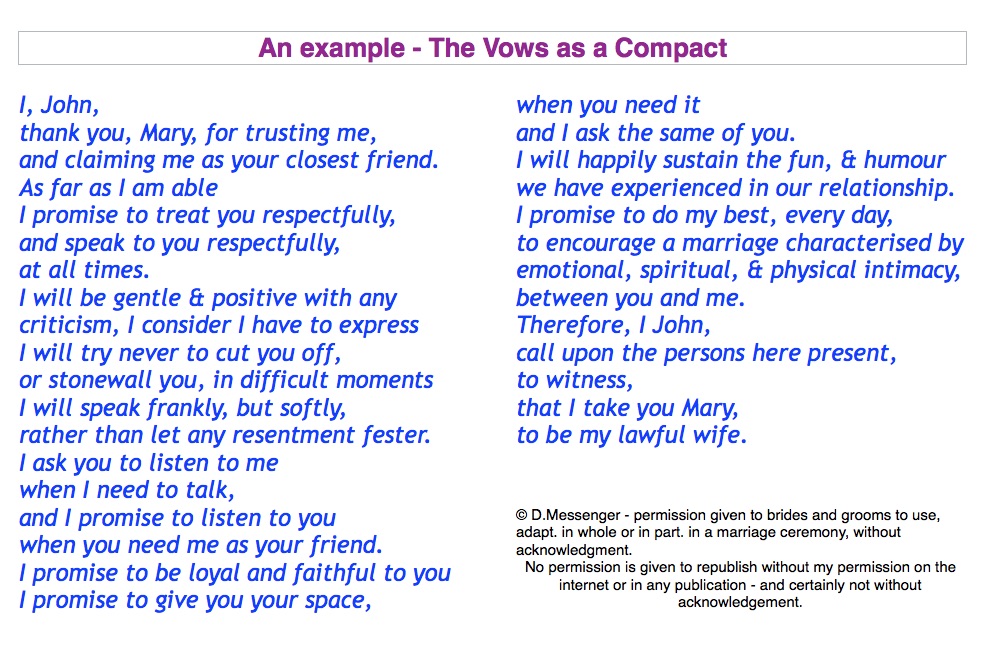
Celebrants: The wedding Vows as a compact
Celebrants: The Wedding Vows as a Compact

Celebrants: Meeting with Public Service April14, 2016
https://iccdiplomas.com/2016/04/24/celebrants-meeting-with-public-service-april14-2016/

Celebrants: Civil Celebrants in New Jersey USA
https://iccdiplomas.com/2014/07/18/civil-celebrants-in-new-jersey-usa/

Celebrants: Signatures on the Decorative Marriage Certificate (Australia)
https://iccdiplomas.com/2015/06/05/signatures-of-the-decorative-marriage-certificate-australia/

Celebrants: Civil Celebrant Ceremonies Enrich the Culture and preserve genuine values
https://iccdiplomas.com/2018/05/01/civil-celebrant-ceremonies-enrich-the-culture-and-preserve-genuine-values/

Search Ceremony etc etc

http://www.collegeofcelebrancy.com.au/Pages5/DRM_To_AG_Brandis.html

http://www.collegeofcelebrancy.com.au/pages4/roxonopenltr4.html

http://www.collegeofcelebrancy.com/pages4/OpenLtrToDreyfus.html 

http://www.yourmarriagecelebrant.co/informs_re/Oz_CMCs-probs.html 

Celebrants: The objective, the plan, the vision

Tuesday, 17 September 2019

Dear public servants and fellow delegates,

Without a vision, the people perish.

In the last few years I have been looking at your Agendas and Minutes and find myself with a growing feeling of despair. I cannot detect the vision any more.

Let me explain. There are two groups in Australia who are good examples of those who understand deeply what the word “culture” means – the Aboriginal people and the Jewish community. Their lives are full of ceremonies and rituals all year round and all life through. They know who they are, and to whom they belong, because their values and beliefs are enshrined in these events.

Photo: Remi Messenger

When I was young, Christian church attendance dominated the lives of most people. The church and Christian organisations (e.g Boy Scout/Girl Guides, the YMCA, YWCA, YCW, CYO) dominated most Australian lives. The rich rituals and ceremonies of the Christian communities expressed, transmitted and reinforced values (most of them really good and still are), recognised achievements, and communicated self worth. How proud I was as a cub when I was awarded my badge for tying knots, putting up a tent and swimming 50 yards!).

These ceremonies connected communities and celebrated our history (think Anzac Day). Ceremonies helped people adjust to change – the marriage ceremony being an obvious example.

In addition to values, self belief and self worth, I gained a sense of identity (I was a cub, I was catholic, I was an Australian, I was a Messenger). And there’s more —- the Christian religion was full of stories, literature, songs, unbelievably beautiful music, choreography, symbolism, architecture, sculpture (pseudo sculpture!) and  paintings. The whole range of the visual and performing arts were communicated through the churches and their offshoots.

But then, for reasons I won’t go into here, the churches started to take nose dives. Church attendance dropped dramatically.

It was the renowned philosopher / businessman / philanthropist, Gordon Barton, who declared publicly that the biggest challenge facing the western world, in the Australian context, was to create a believable culture to replace the Christian churches. I think he said “filling the cultural vacuum”.

To over-explain. In Barton’s insight, the growing body of secular people needed a culture. They needed ceremonies, rituals, traditions, ceremonial constructs to acknowledge achievement, to engender identity, to establish values, to express the arts.

This has happened to a certain extent, but to my mind the greatest contribution to our secular culture came from our statesman founder, Lionel Murphy. He used his position as Attorney-General in the Whitlam government to enrich Australian society. He considered the establishment of civil celebrants one of his greatest achievements, if not his greatest achievement. He saw it as a reform that permeated the whole society, which he believed would do substantial and lasting good.

He saw celebrant ceremonies as the base of a rich culture for secular people; a culture that was honest, authentic, flexible, creative, and enriching.  He saw a complex of ceremonies in our society as touching and improving almost every individual, deepening their “spiritual” life.

Legalities were important – and Murphy could easily claim to be our greatest law reformer. But to him, when it came to celebrants, it was the human person who was paramount. He was well aware that happiness depends on how we think about ourselves, how we perceive others think of us, and what we think of of them. The values were psychological, societal, communal, familial, “spiritual”. Ceremonies, which humans have evolved to communicate in the most serious way we can, can achieve these ideals in many different ways and  circumstances. The better the ceremony, the more it achieves its aim.

This was his vision.
—-
So I ask, where is the concern and support for current celebrants to learn to create the full range of meaningful substantive ceremonies?

Dally Messenger III STB, LCP, BEd, DipLib, ALAA

Currently: Principal of the  International College of Celebrancy
Sometime Lecturer – Victoria University – Graduate Diploma in Arts (Celebrancy)

Sometime Lecturer – Monash University – Graduate Diploma in Arts (Celebrancy)
Foundation President and Administrator of the Australian Federation of Civil Celebrants (1994-1999).
Sometime Life Member of the Australian Federation of Civil Celebrants (1996). (Until they abolished Life Members !!)
Life Member – Celebrants and Celebrations Network
Foundation President of the Australian Association of Funeral Celebrants (1978).

Foundation Secretary of the Association of Civil Marriage Celebrants of Australia (1975-1980).
Author, Ceremonies and Celebrations (4 editions) – a handbook for celebrants.
Author, Murphy’s Law and the Pursuit of Happiness: A History of the Civil Celebrant Movement.

dallymessenger@mac.com

*<Badges and Awards are presented to Cub Scouts as recognition of their hard work towards a certain aspect of the Cub Scout program. They are based around a wide variety of achievements and activities and generally include one to three levels of achievement. Once received, Cub Scouts are able to proudly display their hard earned badges on their uniforms.>

A Celebrant’s Notebook: by Anna Heriot – Review

Anna Heriot

Anna Heriot

“Here is an author who deeply understands ritual and symbolism.

If you understand what celebrancy is about, the first of September 2003 is a day which makes you put you face in in your hands and weep. This was the day when a group of uneducated, insensitive, unintelligent and rather vicious public servants, endowed with new and extraordinary government sanctioned powers, set out, knowingly or unknowingly, to destroy the civil celebrant program.

A disillusioned Attorney-General, Daryl Williams, who left the political scene mid-term, must have signed off or approved the changes to the Marriage Act – changes which gave extraordinary new powers to these empire building pubic servants.

The first thing they did was to destroy our worldwide, and uniquely recognised title and identity as “civil celebrants”. Unbelievably, they jumbled us up with the “fringe” clergy (small churches, breakaway religious splinter groups, neo-ethnic religions and the like). 

But it gets worse, celebrancy became a world of overblown legalisms, concocted but baseless legal problems, many of which were  unworkable in practice and erroneous in law. 

But it gets worse still, these “reforms” (god, how I hate that word) stopped a wonderful community program in its tracks. Since that time from the Attorney-General’s department – or rarely from the associations or “training organisations”, I have never seen the words “music”, “poetry”, “story-telling”, “choreography”, “symbolism”, “literary quotations”, “visual arts”, “community bonding”, “relationship strengthening” ,”transmission of values”, “recognition of achievements”, “the power of ritual” – and on and on.

I have put my face in my hands many times since and anguish “Oh, for some understanding, some depth!”

And then along comes Anna Heriot’s book. Talk about fresh air. Not a word about Google, not a word about marketing, not a word about legalisms, not a word about the ever perfectible Notice of Intended Marriage. But here we have a book about people, about ceremony, about resolving issues and communicating and enriching humanity through ritual. 

Anna’s book is divided into three parts. The first part is an appreciation of the history of celebrancy and the main issues which were faced by the founding father. She tells the tale of Lionel Murphy and the issues of love and hate, religious domination of the institutions of society, religious conflict between Catholics, Protestants and to some extent, Jews. Issues of misogyny, social exclusion of divorced women, equality, and most of all, divorce and re-marriage. She lauds the Family Law Act  and civil celebrancy as the means by which persons regained self-respect  and justice through the law.

The second part of Anna’s book focusses on her understanding of secular ritual. She relates her own experiences to Arnold Van Gennep (“The Rites of Passage”) and quotes the philosopher Xunxi from the third century AD.

The meaning of ritual is deep indeed.
He who tries to enter it with the kind of perception that
distinguishes hard and white, same and different, will drown there.

The meaning of ritual is great indeed.
He who tries to enter it with the uncouth and inane
 theories of the system-makers will perish there.

The meaning of ritual is lofty indeed.
He who tries to enter with the violent and arrogant ways of
those who despise common customs and consider
 themselves to be above other men
will meet his 
downfall there.

In the practical sense she illustrates the necessary skills of profoundly attentive listening and animated creative writing of unique ceremonies.

The third part of the book is, in my opinion, the best. It is her stories of her own experiences with people for whom she has been challenged to create ceremonies which have the power and effectiveness to change lives for the better. She calls these stories “vignettes”. 

Here are some first sentences.

“They had started to think, in desperation, they would just have to elope …”

“The bride had married twice in her teens. Two “boofheads” her dad called them …”

“They met through music, and liked each other immediately…”

“This is the heading of the email she circulates, “No more miracles,  I am preparing to die ….”

“Her mother suicides in the city at the age of 53, when she is a teenager…”

“Her twin girls died at birth …”

You get the idea. The book is about the creative challenge of the sensitive compassionate celebrant in the real world. 

by Dally Messenger III

The Title of the book is “A Celebrant’s Notebook”, writer and publisher, Anna Heriot 2018 (edited by Emily Buster). RRP $29.95 ISBN9780-646-98048-5 Hardback. Available from —  annaheriot.com.au – or it could be soon available from the Celebrants Centre – 1300 446 786

Celebrant Ceremonies enrich culture and preserve values

CELEBRANT FRIENDS (AND OTHERS) MAY BE INTERESTED IN THE LETTER I SENT TO THE ATTORNEY-GENERAL (CHRISTIAN PORTER) YESTERDAY (May 1, 2018)

Dear Attorney General
I have just finished watching the Sydney, Canberra, and Melbourne Dawn Anzac services on television.
The woman surgeon who spoke at the Canberra Dawn Service and the other woman surgeon who spoke at the Melbourne Dawn Service movingly articulated the ideals in which they believed—such a contrast to Australian life as we currently observe it.

These Dawn Anzac ceremonies were top illustrations of how ceremonies are meant to preserve our values. The civil celebrant program for which you have responsibility was not established by your predecessors for occasional use, but was instigated to permeate Australian life on all its occasions to express, inter alia, the values we acknowledge as good. Every family and every community is enriched and stabilised by ceremonies and rituals, great and small. This need in our culture has become more acute as church attendance has declined dramatically. In short, Mr Porter, we civil celebrants were established to build and enhance a culture, wherein, at every level of society, our best ideals were expressed, transmitted, and reinforced.

Unfortunately, your predecessors have let us and the country down badly. September 1st, 2003, was a sad day for celebrants. On that day, our whole purpose changed from creating the best ceremonies for the Australian public to a preoccupation with a mass of legal trivia.

In brief, the market was super-flooded with so many badly educated celebrants that original ideals were lost, understanding of the role became almost non-existent, and pre-occupation with ceremonies for the whole spectrum of human life was replaced with celebrant organisations seeking members, celebrant “trainers” without ethics, and individuals grovelling to a public servant, who over-asserted her authority, and who demanded strict adherence to her destructive ideas.
—-
It is important to run a good country—good governance, as we call it. It is important to develop a culture that supports decency, values, and principles. Civil ceremonies are one of the main means we have to influence society for the better.

Until that tragic day in 2003, Australia led the western world in civil ceremonies. Civil celebrants were abolished on this day and jumbled up with an unwilling clergy—a situation in law you have the power to rectify.

Lest this letter get too long to read, and just in case you are interested in this program, I have two recommendations for starters.

Recommendations for starters: re Excessive numbers of celebrants: a full or partial moratorium on appointments.

1. That in the next meeting of your representatives with celebrants, the topic of excessive numbers should not be passed over until action is planned to begin solving the problem. My recommendation is a full or partial moratorium on appointments and a waiting list. As a partial moratorium, say, one appointment for every four who leave the list. (This has been done before.)

2. Then, once something concrete has been decided about no. 1 above, the meeting should discuss purpose. Similarly, the meeting should not be allowed to continue until they have progressed towards expanding and encouraging the range and quality of the ceremonies that our society so badly needs.

3. My impression of your current staff is that they are decent people without the malice we have experienced in the past. But you, as Attorney-General, should not tolerate in the marriage celebrant section staff any public servant who does not understand and support the purpose of the civil celebrant program and who sincerely wishes, according to the highest ideals of the public service, to progress it.

Mr Porter, there is nothing better you could be doing for Australia, for its lasting good, than using your influence to enrich the culture of this country. The civil celebrant program began this way, and continued this way for a long time. I defy you to name anything in your portfolio of responsibilities that is more important than the spiritual life of the nation itself.
With sincere good wishes for success in your portfolio,.

Yours sincerely

Dally Messenger III STB, LCP, BEd, DipLib, ALAA

Currently: Principal of the International College of Celebrancy
Sometime Lecturer – Victoria University – Graduate Diploma in Arts (Celebrancy) Sometime Lecturer – Monash University – Graduate Diploma in Arts (Celebrancy) Foundation President and Administrator of the Australian Federation of Civil Celebrants (1994–1999).
Life Member – Celebrants and Celebrations Network
Sometime Life Member of the Australian Federation of Civil Celebrants (1996).
(Until they abolished Life Members !!)
Foundation President of the Australian Association of Funeral Celebrants
(1978).
Foundation Secretary of the Association of Civil Marriage Celebrants of
Australia (1975-1980).
Author, Ceremonies and Celebrations (4 editions) – a handbook for celebrants.
Author, Murphy’s Law and the Pursuit of Happiness: A History of the Civil Celebrant Movement


PS. In case I am maligned,. I consider legalities important, and I have always advocated exactness in the recording of marriages and practised it with exactness in my own celebrancy. But it is not the main game—ceremonies are!

Dally Messenger


This is the reply I received via our representative at the Meeting with the Attorney General’s representatives

As Yvonne Werner will testify, I raised your recent letter to the AG with the MCLS staff at the associations meeting here in Canberra yesterday. They said they had read it. Nonetheless, I raised the point of oversupply & moratorium in front of all. They simply said that the law says that if a qualified fit & proper person applies, the registrar has to appoint. ‘A moratorium or a delay (4 to 1) in appointments will not happen.’  I tried. I hope you are well. Charles 😎👍🏼

My Note: In the past, the Marriage Act and the Regulations, especially those that oppressed celebrants, were changed in the blink of an eye.

Civil Celebrant or Commonwealth Registered Celebrant?

Section 39 of The Marriage Act in Australia should be changed back so as to clearly distinguish clergy from Civil Celebrants. The destructive change in 2003 should be seen for what it is – an attempt to destroy the civil celebrant program and a wonderful uniquely Australian social innovation.

Students of the International College met at Circular Quay in Sydney

Students of the International College met at Circular Quay in Sydney

THIS IS IN REPLY TO A GROUP OF NEW CIVIL CELEBRANTS WHO COMMENCED A PUBLIC DISCUSSION REGARDING WHAT WE SHOULD BE CALLED.
How very distressing to see these wounds opened up. But maybe opening this wound up it can be healed!

From the beginning we were “civil marriage celebrants” or “civil celebrants”. In 1977. When the dispute about what we should do emerged, the founding Attorney-General, Lionel Murphy, weighed in to publicly state (he was then a Judge of the High Court) that civil celebrants were to officiate at all the ceremonies the non-church world needed, in those days marriages, funeral and namings. We were to be seen as enriching the culture in every way we can.

In perhaps the most catastrophic day in the history of Civil Celebrancy, Sept 1 2003, a group of ignorant and/or malicious public servants in the Attorney-General’s Department ravaged the Civil Celebrant program by jumbling up civil celebrants with the fringe clergy. This was  a surprise change never envisaged, a change the clergy did not want, and we civil celebrants did not want.

We were stripped of our proud title of “Civil Celebrants” and cast into the dishonest and limited world of legal trivia and fear administration, which ignored 30 years of cultural and legal precedent. This recalcitrant act partly destroyed the vision of Lionel Murphy.

Since this catastrophic day I have been sick in the stomach regarding what passes for training in celebrancy.  We now have the ignorant setting syllabi for the new and untrained.

With due modesty may I ask members of this forum to read my book “Murphy’s Law and the Pursuit of Happiness: a History of the Civil Celebrant Movement”. It is well reviewed as “readable”. The history of celebrancy should be essential in every course of training. You can get the book from Yvonne on 1300 446 786. You can get it as an ebook on iBooks or at Amazon/Kindle at https://www.amazon.com/Murphys-Law-Pursuit-Happiness-Celebrant-ebook/dp/B00GSYEDFK?ie=UTF8&keywords=Murphy%27s%20Law%20and%20the%20Pursuit%20of%20Happiness&qid=1384990080&ref_=sr_1_1&sr=8-1

If participants have some accurate information, we can then have the facts which will lead to discussions, which will lead to progress in the form of information — and inspiration to be better celebrants.

Finally, may I ask all celebrants to campaign strongly with the Attorney-General to restore our proud title of “Civil Celebrants” and restore our original purpose of being top class ceremony providers, and to rescue us from the morass of legal trivia which now passes for celebrancy.

Dally Messenger