History teaches us
that men behave wisely
once they have exhausted
all other alternatives.
Abba Eban
After studying this unit, the student should:
- Understand Lionel Murphy’s part in developing the civil celebrant movement in light of his contribution to Australian society in general.
- Know about the challenges, difficulties, issues, and problems faced by the fledgling program and what lessons can be learned from this history.
- Be familiar with the practical, philosophical, and administrative issues that are part of the program’s history.
- Be able to compare the development of the Australian program with similar initiatives in other countries and be able to discuss the main differences and how they came about.
- Be familiar with the key issues of debate in the development of civil celebrancy, e.g.:
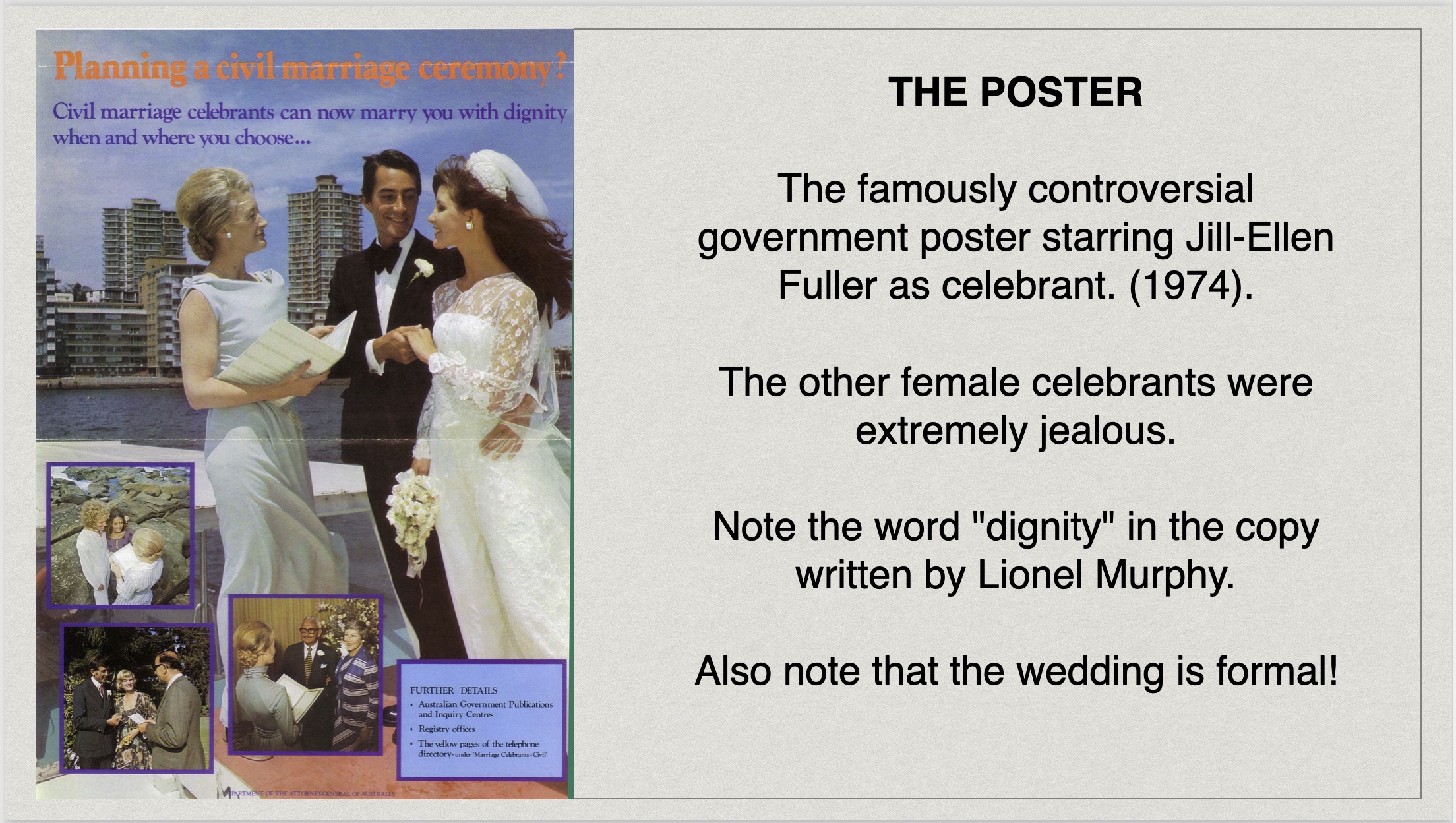
Key issues and Questions
- Is it a community service or a profession?
- Do celebrants represent non/anti-religious groups or the general community?
- celebrants of marriage only, or celebrants of the ceremonies people need?
- celebrants chosen from those trained in particular areas, such as the arts or the law?
- Should celebrants go by instinct or be educated and trained?
- Should the ceremony be the choice of the celebrant or the choice of the people?
- Should the program be regulated by the government or deregulated in the marketplace?
- Should we think of civil ceremonies as less aesthetically pleasing and powerful than church ceremonies, or equal, or better ?
Assessment
Assessment tasks are on the last pages of the module manual. All assessment tasks are carefully read, critiqued, and assessed by your tutor.
Assessment is by the following methods:
- Learning journal—a diary relating your studies to the world in which you live, including compulsory research and writing tasks where necessary.
- Research questions—on selected written material provided with the module manual, books, videos and website links, especially “Murphy’s Law and the Pursuit of Happiness: A History of the Civil Celebrant Movement ”.
- Fieldwork—structured interviews with pioneer, original, and/or key celebrants and/or historians, authors, journalists, commentators, or philosophers with knowledge of celebrancy.
- Literature Review—a structured analysis of the Module 7 manual of selected writing and movies/videos.

Workload and Due Dates
The time envisioned for working on each unit is equivalent to 10 weeks at 8 hours per week. The college has not set dates for submission of individual items. However, unless special permission to extend is granted, this module is to be completed within 6 months. Temporary suspensions of enrolment are negotiable; however, fees for modules that have not been completed are not refundable.
Readings, Questions and Assignments
All manuals and videos are provided, including “Ceremonies and Celebrations” if not previously provided, and will be made available immediately once the college receives full payment for the module. If the module manuals, books, videos, and other items are downloaded from our website, a discount will apply. Otherwise the items will be sent by post, airmail where necessary.
Transferring any material belonging to the college to a third party without prior permission is unethical and strictly forbidden.
Correspondence
Correspondence on administrative matters, including enrolments, are to be directed to the principal, Mr Dally Messenger, dallymessenger@mac.com, +61 411 717 303
 International College of Celebrancy (Est.1995)