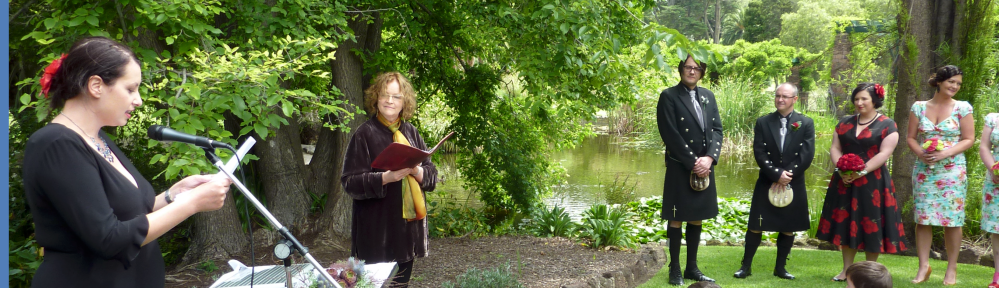
Lecture to Australian Marriage Celebrants (AMC) convention 2023
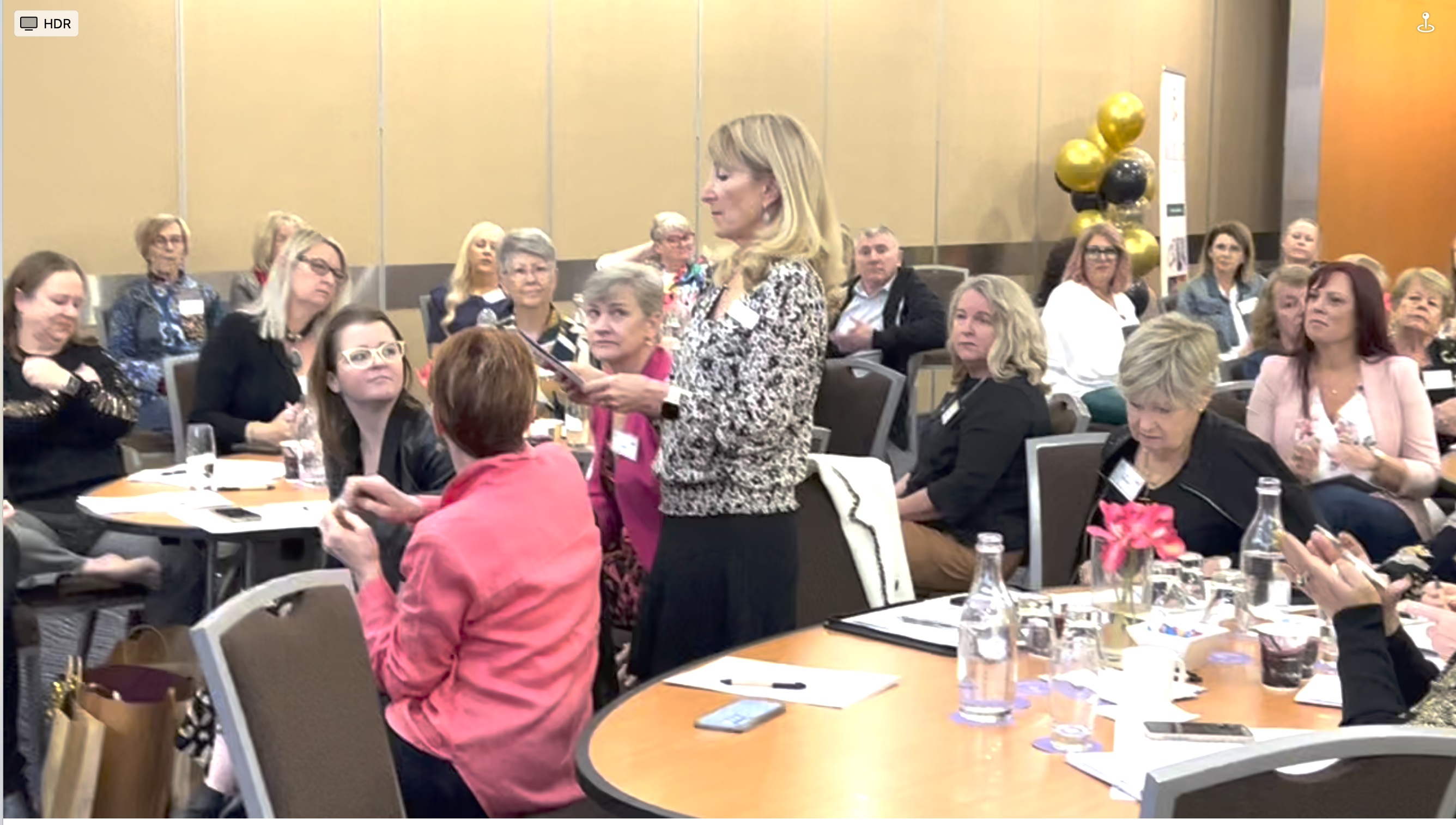
To celebrate 50 Years of Civil Celebrancy held at the
NOVOTEL HOTEL, BRIGTON-LE-SANDS on Saturday, August 26, 2023 by Dally Messenger III

Opening Address Notes (not exactly as delivered!) to the gathering of civil marriage celebrants organised by Kamal Saliby, Annemarie McDonell, Leanne McKay and the committee of the AMC.
Good morning, fellow celebrants,
Thanks so much to Kamal Saliby, Annemarie McDonell, and Leanne McKay for inviting me to give this opening address, and for all they have done in organising this conference honouring our history.
So Garfield Barwick introduces the Marriage Act of 1961.
On a day such as today, it is necessary to record the key moments of our history. That wonderful axiom applies:
Let those who drink the water
remember those
who dug the well.
So we ask ourselves, How did it all happen?
So I will outline for you today some background, a picture of how it was at the beginning, and a few moments in the longer story from 1973 to 2023.
Before 1961, every state had its own Marriage Act. Garfield Barwick, the Liberal Party Attorney-General, and sometime later the Chief Justice of the High Court of Australia decided to combine all the state Marriage Acts into one federal Commonwealth law, the Marriage Act 1961. Its achievement was to apply consistent marriage law to the whole commonwealth.
I was 23 years old at the time, and I remember the media making this out to be an extraordinary achievement. I didn’t think so. But not many reforms went on in those days, so it was hailed. As an aside, you may be interested to know that in 1961, 14 year old girls and 16-year-old boys could be married with permission. It was not until 1991, when I was 53, that both parties had to be 18.
Senator Lionel Murphy enters parliament and campaigns for marriage law reform
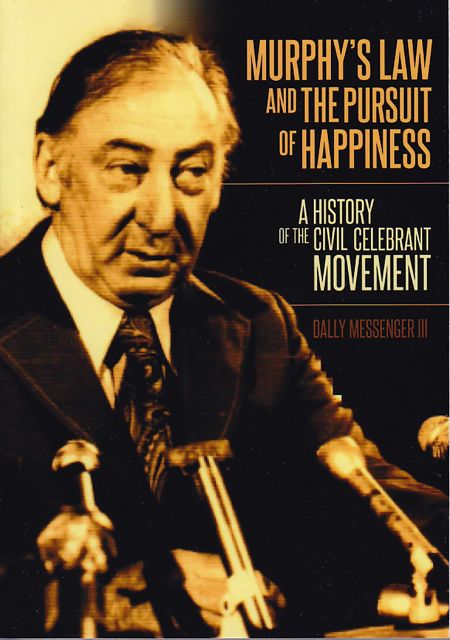
In the same year, on April 30, an idealistic young lawyer in the Labor Party achieved preselection for the Senate by one vote. Nearly two years later (December 1962), he was elected Senator for NSW for the Australian Labor Party. (Hocking, pp. 69–70). His name was Lionel Murphy.
Though he was in opposition, he wanted to do all the good he could as a member of Parliament. So he made friends in the Liberal Party and fought for various causes in a bipartisan way, unthinkable today. He had an axiom he lived by.
If it adds to the sum total of human happiness,
You do it,
And if it doesn’t,
You don’t.
In 1967, he was elected leader of the opposition in the Senate. He put a great deal of his energy, alone, into reforming marriage law in Australia. He almost persuaded the Liberals to support him. He was determined and persistent. But he had a nasty opponent—Liberal Senator Ivor Greenwood.
In her captivating book on Murphy’s life, Dr. Jennifer Hocking recounts how Murphy, almost single-handedly, persisted for several years to achieve the groundbreaking reform of no-fault divorce. The implementation of the Family Law Act, which he eventually achieved when the Whitlam government was elected, brought about a revolutionary change, both legally and socially. After its enactment, it significantly diminished personal animosity within society. The cost of obtaining a divorce plummeted, in general terms, from an exorbitant $200,000 to a mere $400. However, this triumph did not come without an arduous and contentious struggle. Hocking declares:
No Act has provoked such controversy, traversed such a long and arduous parliamentary passage, or undergone such intense public scrutiny as Lionel Murphy’s Family Law Act.
Murphy’s achievement was all the more remarkable when one considers the dominance of religion at the time. The main Christian churches held sway, and visceral religious sectarianism, especially between Catholics and Anglicans, was a curse that plagued Australian society.
Dally Messenger becomes the first applicant to perform civil marriages.
But going back a bit I had studied this new Marriage Act of 1961 while I was in the seminary. Under Section 39, I applied for the authority to officiate at marriages to oblige a small group of friends who were horrified at the thought of a registry office marriage. Sir Garfield Barwick refused my application on the grounds that I was not affiliated with a religion. It was a different world from the one in which we live today. Religions were strong. Church attendance was high. Non-religious people, secular people, were the pits.
The Whitlam Labor government is elected to office
On December 2, 1972, the Whitlam Labor Government was elected to office. Murphy became Attorney General and leader of the Whitlam government in the Senate.
Attorney General Lionel Murphy achieves no-fault divorce
He was able to implement his radical reform measure—no fault divorce—the Family Law Act, for which he had worked so hard for so many years. It was enacted in 1975, but did not take effect until 1976, after Murphy had been appointed to the High Court in February 1975.
Attorney General Lionel Murphy appoints marriage celebrants, despite widespread opposition
But apart from reforming divorce laws, Murphy was angered by the way marriage ceremonies were conducted.
Allow me to describe the Sydney scene. The space was only open from Monday to Friday, between 10 a.m. and 4 p.m. Within the room, the atmosphere was stark, austere, and disheartening. Couples who were ready to wed, along with their witnesses (only two allowed), were seated in an orderly manner on a long bench, waiting for their turn. A solemn official, with an expressionless face, called them up one by one from behind a desk. A dry and concise legal marriage ceremony followed. Once the ceremony was concluded, the group of four would be dismissed, making way for the next set of couples. At most, couples were permitted to take a single photo away from the desk.
Lionel Murphy, deeply dismayed by the unnecessary humiliation experienced by couples on what should have been a joyful and celebratory day. He took action. As Attorney-General, Murphy recognised an opportunity to restore dignity to secular individuals and divorced Christians in their marriage ceremonies. He utilised a simple provision in Garfield Barwick’s 1961 Marriage Act (Section 39) to empower ordinary citizens, unaffiliated with any specific religious group, to officiate at weddings. It was so simple for him, yet its effects were profound. These individuals quickly became known as civil marriage celebrants.
Despite opposition from every quarter—his colleagues in the Labor Party, the public service, and his own personal staff—Murphy, on July 19, 1973, appointed the first Civil Celebrant, Lois D’Arcy.
The true legend of the first appointment
The appointment of the first celebrant is the stuff of legend. On the fateful night of July 19, 1973, under the cover of darkness, Murphy personally typed out the appointment letter for the first celebrant, Lois D’Arcy, a vivacious young mother in her twenties hailing from Queensland. With determination, he then scoured his office until he located an envelope and stamp. After carefully addressing the envelope and moistening and affixing the stamp, he walked to a nearby post office box and firmly slid it into the slot. And thus, the civil celebrant program commenced.
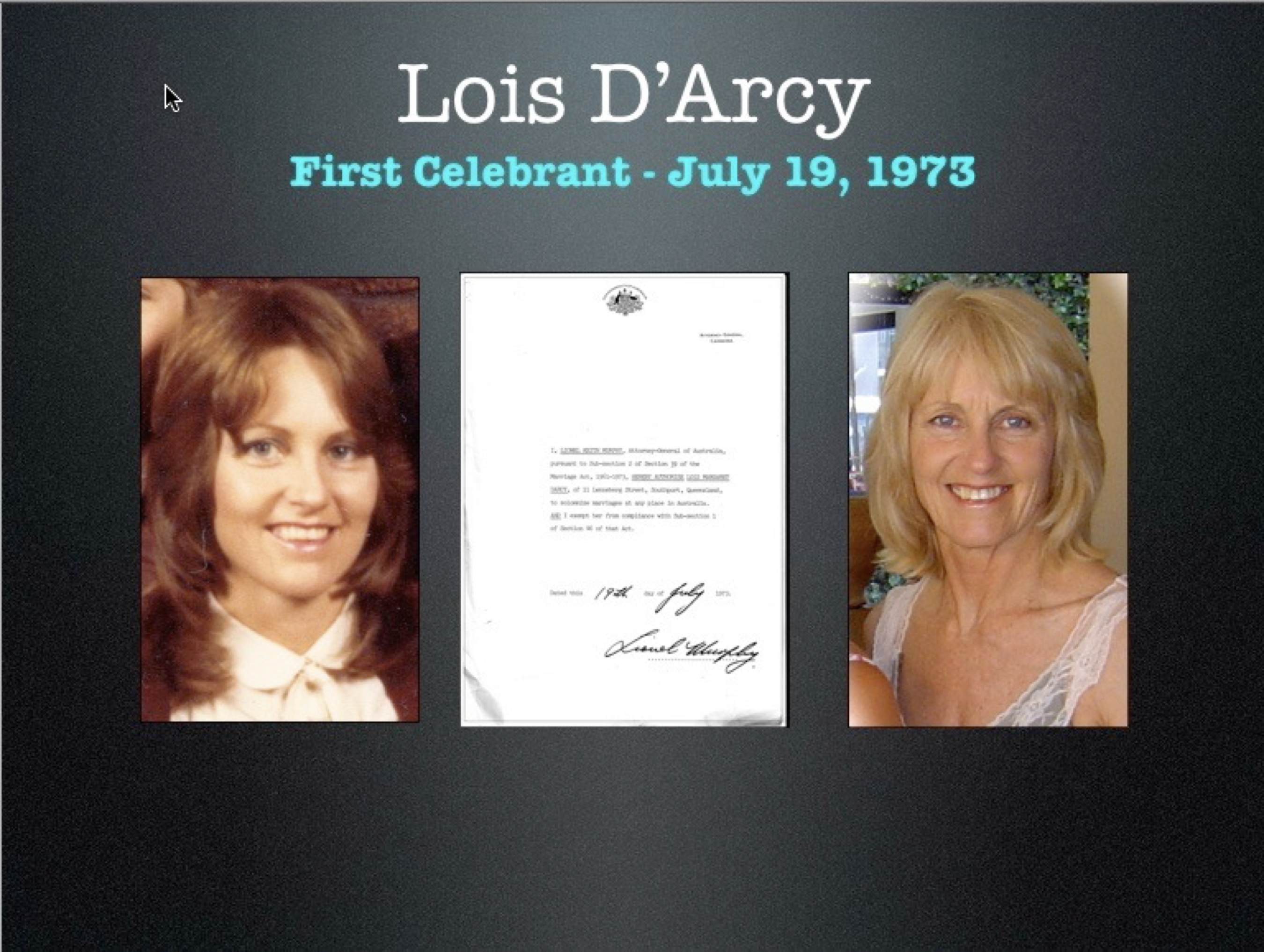
Lois D’Arcy holds the esteemed distinction and honour of not only being the first truly independent civil celebrant appointed in Australia but, as fate would have it, in the entire Western world.
I was No. 17. When a public servant told him about my application to Barwick, he immediately called for my file. They couldn’t find it. He kept on insisting they had found it. Immediately, he sent me a telegram saying he had made me a celebrant. He told me all this himself.
Lionel Murphy’s enthusiastic interest in Civil Celebrant marriages
The program had a slow start. But then it started to roll on. Murphy took an enthusiastic interest in this program – sending telegrams of congratulations to the first several hundred couples married by civil celebrants. He would often unexpectedly turn up uninvited to weddings performed by celebrants, to mix with the couple and guests, and to delight in his achievement.
The radical reform of civil marriages
In the context of the time, appointing Mrs. D’Arcy was a truly radical reform. It was not just the power to “do” a wedding ceremony, It was the ideal to establish the kind of marriage ceremony that he felt would bring the most freedom and dignity to the ordinary person who was not a churchgoer. I interred him in the seventies; he used the word dignity 27 times.
His radical reform was that celebrants were to guide people in choosing their own ceremony, one that was most consistent with their values and ideals. The reader should understand the fierce criticism that was then in circulation regarding the words in church ceremonies that belittled women and non-believers.
Couples now had the freedom to choose their own celebrant, their own place, and their own time—liberties unheard of in the western world up to this point. He furthered the cause of women in our society by appointing mostly female celebrants. He appointed aboriginals. He appointed young people. He encouraged substance and beauty, in the components of the marriage ceremony, and later in funeral ceremonies.
Murphy appointed Messenger the first secretary of the organisation he founded.
On May 3, 1974, Murphy called upon every celebrant who could make it to his Sydney office to establish an association. Gathered before his desk, he addressed the twenty or so individuals present, expressing his conviction that the Whitlam government would inevitably lose the upcoming election. He was convinced that the Liberal Party would probably consider discontinuing the Civil Celebrant program to gain favour with the churches. In light of this, he announced that our most prudent course of action would be to unite by forming an association. He founded it there and then. The name became, and I made a contribution here, “The Association of Civil Marriage Celebrants of Australia,” the ACMCA.
In the aftermath, he made me the inaugural secretary of the association. His charge to me was clear: elevate the standards, dignify the ceremonies, and foster a collaborative sharing of resources. These concepts were novel to us at the time. Above all, his unwavering interest drove us forward. Navigating a fair share of media attention fell within my responsibilities as well.
Reflecting on those times, I’ve come to realise the profound positive impact he achieved in people’s lives through legal and human means. I felt great pride in being his “man on the ground.” His enthusiasm was infectious. As an aside, I have observed that government initiatives thrive only when a Minister remains engaged. Remarkably, in times of trouble, I could simply dial Canberra and be instantly connected to Murphy’s desk—an unimaginable convenience in today’s world.
During those years, our primary means of communication was by post, a labor-intensive process. Mobile phones, emails, Google, Wikipedia, Trove, and even chatGPT were nonexistent luxuries. Long-distance phone calls incurred exorbitant costs. It’s important to note that I was a volunteer.
Frequently, I would visit the office of the local Labor Member of Parliament for Dandenong, Max Oldmeadow, to mail letters and make those pricey long-distance calls. To this day, I extend my gratitude to the taxpayers. All my efforts were, ultimately, for your benefit.
Max was a gem, consistently aiding me in responding to celebrants across Australia. Lionel appointed 99 celebrants. We exchanged ceremonies, poems, ideas, and, yes, even mistakes. As there was no such thing as a portable PA system, we exchanged techniques for projecting our voices. A voice specialist celebrant, Jane Day, held classes on voice projection and clear diction. She quoted the preacher George Whitfield, whose projection and diction could be clearly heard by upwards of 10,000 people listening in the open.
The Gestetner machine ran ceaselessly as I sent out regular posts containing poems, ring wordings, vows, and valuable tips for organising, planning choreography, and placements.
Max was a gem, consistently aiding me in responding to celebrants across Australia. Lionel appointed 99 celebrants. We exchanged ceremonies, poems, ideas, and, yes, even mistakes. As there was no such thing as a portable PA system, we exchanged techniques for projecting our voices. A voice specialist celebrant, Jane Day, held classes on voice projection and clear diction. She quoted the preacher George Whitfield, whose projection and diction could be clearly heard by upwards of 10,000 people listening in the open.
 International College of Celebrancy (Est.1995)